Summer Heat Index Calculator
Find out how hot it really feels using temperature and humidity freely. Stay safe during extreme summer heat with our accurate free heat index calculation web tool.
What is Heat Index?
Heat index is the “feels like” temperature, how hot our body actually feels when humidity is combined with surrounding air temperature.
When humidity is high, sweat does not evaporate efficiently, making it harder for our body to cool down. This is why hot and humid days feel much worse than dry heat.
How Does Our Heat Index Calculator Work?
Our Heat Index Calculator uses the official National Weather Service (NWS) formula to estimate how hot it actually feels on our body based on temperature and humidity.
Here’s exactly what happens when you use the tool:
- Step 1: You enter the air temperature and humidity level
- Step 2: The tool converts your input into the correct unit system (°F or °C)
- Step 3: It applies the official heat index formula used by weather agencies
- Step 4: The result is converted back into a “feels like” temperature
- Step 5: Based on the result, the tool assigns a risk level (Safe, Caution, Danger, etc.)
This means you’re not getting a guess — you’re getting a scientifically calculated “feels like” temperature used in real-world weather forecasts.
Keep in mind: the result assumes shade and light wind. Direct sunlight can increase the heat index even further.
How to Calculate Heat Index
In Fahrenheit:
Heat Index = -42.379 + 2.04901523×T + 10.14333127×RH − 0.22475541×T×RH − 0.00683783×T² − 0.05481717×RH² + 0.00122874×T²×RH + 0.00085282×T×RH² − 0.00000199×T²×RH²
(T = temperature, RH = humidity)
Heat Index Risk Levels
Caution: Fatigue possible
Extreme Caution: Heat cramps possible
Danger: Heat stroke possible
Extreme Danger: Serious risk
Prevention & Safety Tips
- Drink plenty of water
- Avoid peak sun hours
- Wear light clothing
- Take breaks in shade
- Never leave kids in cars
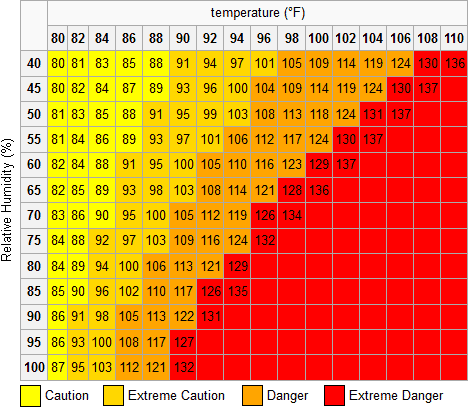
How to Read Heat Index Chart
A heat index chart helps you understand how hot it actually feels based on air temperature and relative humidity. Instead of relying only on temperature, the chart combines both factors to show the “feels like” temperature.
To use the chart:
- Find the air temperature on one axis
- Find the relative humidity on the other axis
- Locate where they intersect
- The result is the heat index (feels like temperature)
For example, if the temperature is 35°C and humidity is 60%, the heat index can feel like 45°C or more.
Keep in mind that most charts are designed for shaded areas with light wind. Direct sunlight can increase the heat index by up to 10–15°F (5–8°C).
Heat Index Effects and Risk Levels Explained
Heat index represents how hot it feels to our body when temperature and humidity are combined. When humidity is high, sweat evaporates slowly, making it harder for the body to cool itself.
This can lead to overheating, dehydration, and serious heat-related illnesses such as heat exhaustion or heat stroke.
| Heat Index (°C) | Risk Level | Possible Effects |
|---|---|---|
| 27–32°C | Caution | Fatigue possible with prolonged exposure |
| 32–41°C | Extreme Caution | Heat cramps or exhaustion possible |
| 41–54°C | Danger | Heat stroke possible with prolonged exposure |
| Above 54°C | Extreme Danger | Heat stroke highly likely and life-threatening |
Important: Children, elderly individuals, and outdoor workers are at higher risk because their bodies may not regulate heat as efficiently. Staying hydrated and limiting exposure during peak heat hours is essential.
Different Methods to Measure Heat Stress
There are multiple ways to estimate how hot it feels in summer. Below is a comparison of the most commonly used methods — including our Heat Index Calculator.
| Method | What It Uses | Accuracy | Best For |
|---|---|---|---|
| Heat Index Calculator | Temperature + Relative Humidity | High (official weather standard) | Daily weather, public forecasts, safety alerts |
| Using Dew Point Temperature | Temperature + Dew Point | Very High (more precise humidity measure) | Scientific analysis, advanced weather tracking |
| Using Relative Humidity | Humidity percentage only | Moderate (less precise alone) | Basic understanding of moisture in air |
Key Insight: Heat Index is the most practical method for everyday use because it combines both temperature and humidity into a single “feels like” value. Dew point provides more scientific precision, while relative humidity alone gives only a partial picture.
Why Use Heat Index Calculator?
Our free tool helps you understand real heat stress risk instead of relying only on temperature.
FAQ
Does heat index change actual temperature?
No. The air temperature stays the same. Heat index only shows how hot it feels.
Can heat stroke happen below 40°C?
Yes. High humidity can make lower temperatures feel dangerously hot.