Friends, Snow day prediction tools are now very popular across Canada and the USA. Students check them at night. Parents check them early in the morning.
Teachers quietly check them too. The big question people ask is simple: is the snow day calculator accurate enough to trust?
The honest answer is this. These tools can be helpful, but they are not officially perfect. They give probability, not official decisions. Only a few of them which use API services to calculate snow day weather data are good such as cold day calculators.
Let us break this down with real information, real limits, and how to use them the smart way.
What is the Snow Day Calculator?
The Snow Day Calculator is an online prediction tool or free website that estimates the chance of school closures during winter storms.
It uses local weather forecast data like snowfall amount, temperature, and timing to generate a probability score.
Families and students use it to get an early idea of possible snow days, not official confirmation.
It works as a guidance tool, while final closure decisions still come from the school district.
What a snow day calculator actually does
A snow day calculator is a digital and online free tool that estimates the chance of school closure based on weather inputs. Most tools ask for ZIP code or city name. Then they pull forecast data and run it through a prediction model.
These models often use
- Expected snowfall amount
- Temperature trends
- Wind speed and wind chill
- Storm timing
- Past closure patterns
Some newer platforms also use machine learning trained on past district behavior. That improves estimates, especially in snow heavy regions.
But make sure it is still a prediction layer built on weather forecasts, not on school board decisions.
Region wise snow day calculator accuracy comparison
Snow day prediction accuracy is not the same across every region. It changes based on local weather patterns, snow handling systems, and school closure culture. Areas that get frequent winter storms usually have better trained prediction models, while mixed climate regions show more variation. Use this table as a practical guide, not a fixed rule.
| Region | Average Accuracy | Note |
| US Northeast, NY MA ME | 88% to 98% | Frequent winter storms and closure history improves model learning |
| Midwest, OH MI IL | 75% to 85% | Depends on district policy and road treatment speed |
| Southern Canada, ON QC | 70% to 80% | Higher accuracy in major metro areas than rural zones |
| Prairies, AB MB SK | 60% to 65% | Snow common, but schools often stay open |
| Mountain West, CO UT ID | 65% to 75% | Elevation and microclimates create forecast variation |
| Southern US low snow states | 80% to 90% | Even small snowfall often leads to closures |
Is snow day calculator accurate for short term forecasts
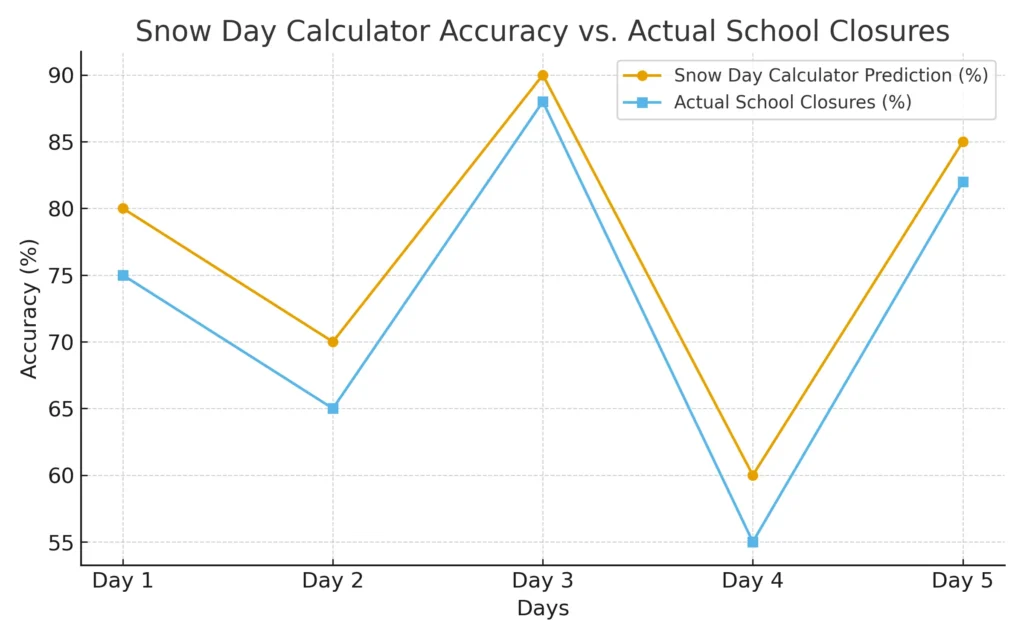
For near term storms, accuracy is fairly decent. Most independent reviews and user reports place accuracy around 60 to 75 percent for predictions within 24 to 48 hours.
Some tools claim higher numbers like 90 percent or more. In reality, that level only happens in very obvious storm setups, like major blizzards where closure is almost certain anyway.
Short range forecasts work better because weather models are more stable close to the event. When the storm is already forming and tracked well, prediction tools perform better.
Beyond two days, reliability drops fast. Long range closure predictions are more pattern based and less dependable.
Why results look right sometimes and wrong other times
People often ask if the snow day calculator is accurate when it shows a high percentage but school still opens. This happens because weather is only one part of the decision.
School closure is a human call made by district leaders.
They also consider factors calculators cannot fully see.
Examples include
- Bus driver availability
- Road treatment status
- Power outages near schools
- Building heating issues
- Local policy on delays vs closures
A calculator might show an 85 percent chance based on snow totals. But if roads are cleared early and buses can run, the district may still open.
On the other hand, a smaller storm can cause closure if ice forms or buses cannot operate safely.
Regional differences reduce prediction accuracy
One major accuracy gap comes from regional snow tolerance. Different areas respond differently to the same snowfall.
Northern regions like parts of Minnesota, Alberta, or Vermont are built for snow. Plows are ready. Drivers are experienced. Schools may stay open with six inches.
Southern or low snow regions like parts of Tennessee or southern Ontario may close with two inches because infrastructure is lighter.
Some Reddit style user feedback often points this out. Users from heavy snow regions say calculators over predict closures. Users from low snow regions say tools under predict them.
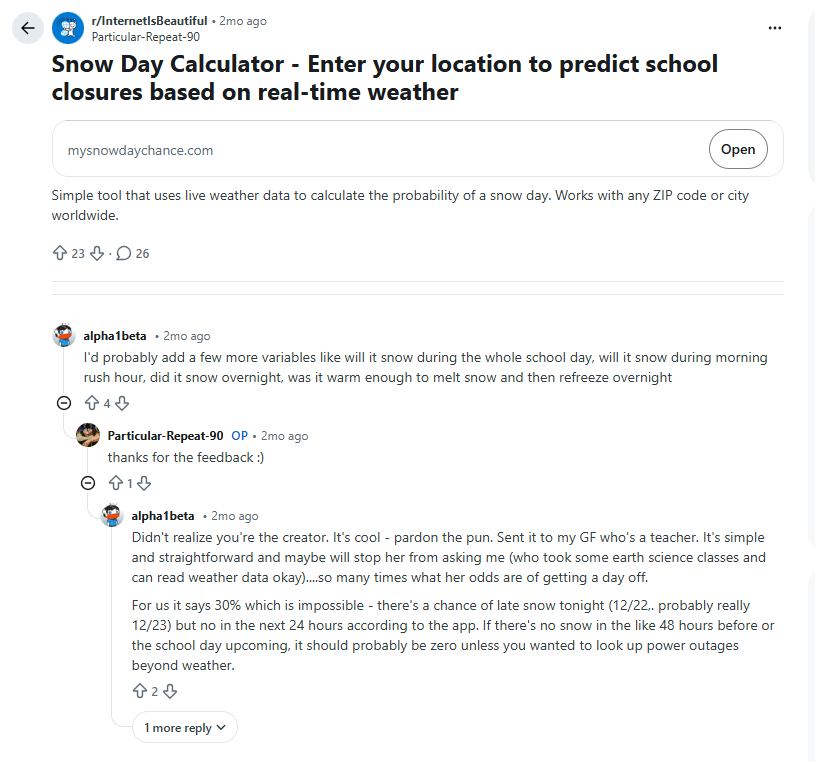
Image credit Reddit : sub reddit internet is beautiful
Unless the model is tuned by region, results can feel off.
Storm timing matters more than totals
Another factor many users mention is timing. When snow falls matters as much as how much falls.
Morning rush hour snow between 4 am and 8 am has a much bigger impact on closure decisions than evening snowfall.
Overnight snow that stops early may allow plows to clear roads before buses run. Calculators that focus mostly on total inches can miss this timing effect.
Example from user feedback,A tool showed a 30 percent chance because totals were low. But snow hit exactly at bus time and school closed. Timing changed the outcome.
Better tools now try to include hourly forecast timing, but not all do it well.
Data quality and search input issues
Accuracy also depends on correct location matching. Some tools struggle with city name searches. Users report getting results for the wrong Paris or London unless they type country with a comma.
If the location is mismatched, the forecast input is wrong, and the prediction becomes unreliable.
Some calculators are also limited by their weather data provider. If forecast data updates slowly, predictions lag behind real storm changes.
Rapid storm track shifts are a known failure point. A last minute storm wobble can make a prediction useless.
Should families trust snow day calculators
Snow day tools are best used as guidance, not confirmation. They are good for setting expectations, not making final plans.
Use them to understand probability, not certainty. Think of them like a weather chance of rain percentage.
Best practice is simple
- Check the calculator for trend direction
- Watch local forecast updates
- Wait for official district alerts
If a tool shows very high probability and forecasts agree, chances are good. But the final word always comes from the school district.
At Last
So, is the snow day calculator accurate? Yes for rough short term probability. No for guaranteed outcomes. Most tools land in the moderate accuracy range and perform best within one to two days of a storm.
They improve each year with better data and smarter models. Still, they cannot see every local decision factor.
Treat them as smart estimates, not official answers. That mindset keeps expectations realistic and avoids early morning surprises.
Also Read:
How Schools Decide Snow Days and Closures Your Complete Guide
What Is Wind Chill and How Is It Calculated
Resources:
https://www.punjabnewsexpress.com/business/news/how-do-online-snow-day-prediction-tools-work-317127