Hello Friends, when winter storms hit across the USA and Canada, one big question comes up in every home, how much snow is needed to cancel school.
Many people assume there is a fixed number of inches that automatically creates a snow day. In reality, school closure decisions depend on more than just snowfall totals.
In this guide, we will explain how schools decide snow days, how many snow days do schools get, what snowfall amounts often trigger closures, and when announcements usually happen.
You will also learn how to check if today is a snow day for schools and how to measure snowfall at home correctly.
What is snowfall and how it is measured
Snowfall is the amount of snow that falls from clouds and collects on the ground during a winter weather event.
It is measured by checking the depth of freshly fallen snow on a flat, level surface. Want to learn more in detail how to measure snow fall you can check our blog.
Weather observers use a ruler or measuring stick placed straight down into the snow to record the depth.
For accuracy, several readings are taken and averaged to get the final snowfall measurement.
How much snow does it take to cancel school
There is no universal snowfall number that cancels school everywhere. Different districts use different thresholds based on road safety, bus routes, and local snow readiness.
In heavy snow regions, schools may stay open with 5 to 8 inches because plowing systems are strong. In low snow regions, even 2 to 3 inches can shut schools down because roads become unsafe quickly.
Wet snow, ice, and freezing rain often cause closures faster than dry powder. Timing also matters. Snow falling during morning travel hours raises closure chances more than evening snowfall.
Is 4 inches of snow enough to cancel school
Is 4 inches of snow enough to cancel school depending on where you live and when it falls. In many northern districts, 4 inches alone may not cancel classes if roads are cleared early.
But in southern or low snow areas, 4 inches is often enough for a closure or delay. District leaders also check wind, visibility, and temperature. If wind chill is dangerous, schools may close even with lower snowfall totals.
Morning road conditions matter more than storm totals on paper.
How do schools determine snow days
Many families ask how schools determine snow days behind the scenes. The decision is usually made by a district operations team, not just one person.
They review
- Weather forecasts and radar updates
- Road condition reports
- Bus route safety checks
- Wind chill and temperature risk
- Power and heating reliability in buildings
Transportation supervisors often test drive routes before sunrise. If buses cannot run safely, closure becomes more likely. Student safety is always the main factor.
You can also use free online snow day calculator tools to guess snowfall.
What time do schools call snow days
Parents often want to know what time schools call snow days so they can plan the morning. Most districts aim to decide between 5 am and 6 am.
Rural districts sometimes decide earlier because routes are longer. Large city districts may wait a bit longer for updated road reports.
Alerts are usually sent by
- Text message
- Auto phone calls
- District websites
- Local TV and radio
Always keep your contact info updated with the school so alerts reach you on time.
What schools have a snow day today and where to check
If you are searching what schools have a snow day today, the best source is always the official district channel. Snow day calculators are helpful for probability, but not final decisions.
Check these sources first
School district website
District social media pages
Local news stations
Official alert systems
If you are wondering is today a snow day for schools, avoid relying only on social posts from friends. Go to verified sources to confirm.
How many snow days do schools get each year
How many snow days do schools get varies widely by region and year. Snow heavy states and provinces usually build extra buffer days into the school calendar.
Typical ranges are
- Low snow regions, 0 to 3 days
- Moderate snow regions, 3 to 6 days
- Heavy snow regions, 5 to 10 days
If too many closures happen, districts may add days at the end of the year or convert days into remote learning days.
How many snow days are schools allowed in Michigan
How many snow days are allowed in Michigan has changed in recent years. Many Michigan districts plan for about 6 traditional snow days in the calendar.
After that limit, schools often switch to virtual learning days instead of adding makeup days. That helps keep the academic calendar on track.
Still, exact policy can vary by district, so local rules matter.
How many snow days do Michigan schools get in practice
How many snow days do Michigan schools get in real winters depends on storm patterns. Some mild winters bring only 2 or 3 closures. Harsh winters can push totals beyond the planned buffer.
Northern Michigan districts usually see more closures than southern parts of the state. Lake effect snow zones are especially variable year to year.
How many snow days do Ohio schools get
How many snow days do Ohio schools get is similar to other Midwest states. Many districts plan for around 5 built in closure days.
Some Ohio districts now use blended learning or remote days after the limit is reached. Ice storms are a major factor in Ohio closures, sometimes more than deep snow.
Road icing and refreeze overnight often trigger decisions there.
How to measure snowfall at home the right way
If you want to track storms yourself, knowing how to measure snowfall at home is useful. Use a flat board placed in an open area before the storm begins.
After snow falls
- Place a ruler straight down to the board
- Measure depth vertically
- Take several readings
- Average the numbers
Clear the board between measurements if snow continues. Measure away from buildings and trees for better accuracy.
This gives you a reliable local snowfall total instead of guessing.
Key factors that matter more than snow totals
Many people focus only on inches, but schools look at a bigger safety picture. Snow amount is just one part of the decision.
Other major factors include
- Ice under the snow
- Blowing and drifting
- Extreme wind chill
- Bus route conditions
- Storm timing during commute hours
That is why two towns with the same snowfall can have different closure decisions.
Key factors influencing school snow closures
School closure decisions are not based on snowfall totals alone. Districts across the USA and Canada look at a mix of readiness, timing, and safety risk before calling a snow day.
Regional preparedness matters most
Warm region districts often close with just 1 to 2 inches because plowing and salt resources are limited. Snow belt regions may stay open with 5 to 6 inches or more since crews and drivers are well prepared.
Timing of snowfall is critical
Snow that falls right before or during the morning commute creates higher closure risk. Even small overnight totals can trigger a snow day if roads are still untreated at bus time.
Road and weather conditions matter more than totals
Ice, slush, drifting snow, and very low wind chill can lead to closure even with light snowfall. Extreme cold near minus 35 F wind chill often pushes districts toward closing.
Local district risk decisions
School officials review bus routes, staff travel, and building safety before deciding. Final calls are made locally, not by a national snowfall rule.
Regional snowfall examples that often trigger closures
Different regions tend to close at different snowfall ranges based on climate and infrastructure.
- South and Mid Atlantic areas often close around 0.5 to 2 inches
- Midwest and Northeast commonly close around 6 inches or more
- Many Canadian districts consider closures around 10 to 25 cm, about 4 to 10 inches
These are common patterns, not strict limits.
What real users say on Reddit about snow day decisions
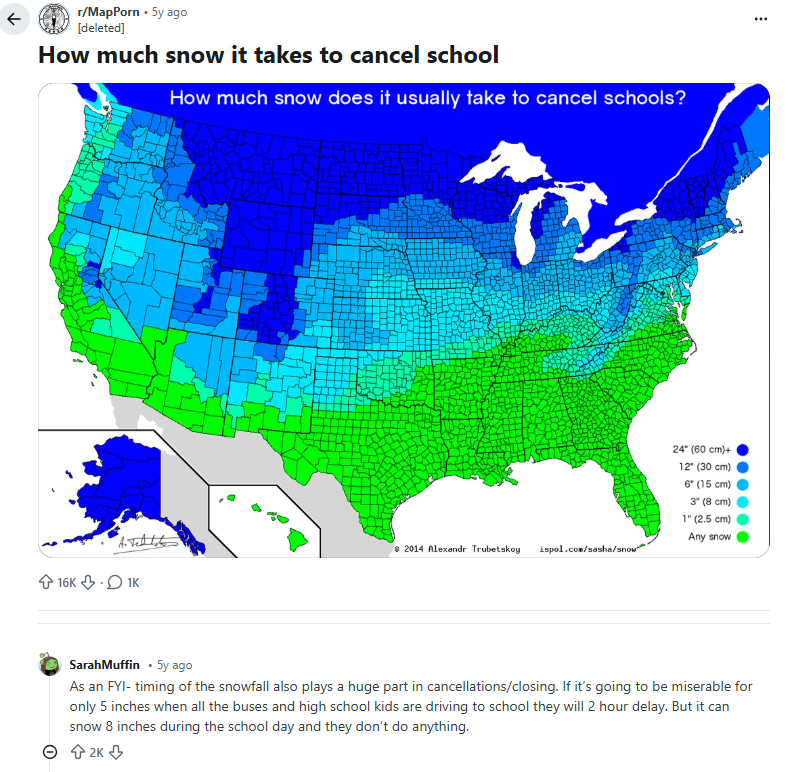
Real world user discussions on Reddit show a clear pattern. Snow day decisions are driven more by timing, road risk, and extreme cold than by a fixed snowfall number. Many long time residents and even school staff repeat the same point, when the snow falls matters more than how much falls.
Users from US Northeast states like New Hampshire shared that 4 to 6 inches can cancel school if it is falling during the morning bus window. The same total overnight often leads to only a delay because plows have time to clear roads. Several commenters said early morning snowfall between about 3 am and 8 am creates the most closures.
Midwest users noted that even 12 plus inches overnight may not cancel school if cleanup is finished before start time. But fast heavy snow right before commute hours causes shutdowns quickly. Multiple comments also highlighted that extreme wind chill near minus 30 F to minus 50 F feels like levels now triggers closures more often than snow itself in some districts.
Canadian users, especially from Alberta, mentioned that some cities almost never close for snow alone. A few joked that only extreme cold near minus 40 C would close schools, not snowfall totals. Location culture and winter readiness clearly change outcomes.
Other users pointed out policy changes. With virtual learning options, some districts now replace classic snow days with remote days. That shift has reduced true closures in certain areas.
Overall Reddit feedback lines up with district guidance. Timing, temperature, and safe travel conditions decide snow days more than a simple inch count.
Here is image attached from reddit for authentication:
Final takeaway
There is no single snowfall number that guarantees a school closure. When asking how much snow is needed to cancel school, the real answer depends on safety conditions, timing, and local readiness.
Use snowfall totals as a guide, not a rule. Watch official district alerts, check road and weather updates, and understand your local snow response level. That gives the most accurate expectation when winter storms arrive.
FAQ
How much snow is needed to cancel school
Anywhere from 1 to 6 plus inches depending on region, road safety, and timing.
How much snow is needed to cancel school in illinois
Usually around 4 to 6 inches, but ice and wind can lower the threshold.
How much snow is needed to cancel school uk
Often 2 to 5 cm can disrupt schools due to limited snow infrastructure.
How much snow is needed to cancel school in ohio
About 3 to 5 inches or less if ice and refreeze are present.
How much snow is needed to cancel school in minnesota
Often 6 plus inches, since districts are well equipped for snow.
How much snow is needed to cancel school in wisconsin
Commonly 5 to 7 inches, lower if wind and drifting are severe.
How much snow is needed to cancel school in texas
Even 1 inch can cancel school in many districts.
How much snow is needed to cancel school in chicago
Typically near 6 inches, but extreme cold can also trigger closure.
How much snow is needed to cancel school in michigan
Around 4 to 6 inches, with lake effect bands sometimes causing closures at different totals.
How much snow is needed to cancel school in indiana
Usually about 3 to 5 inches, depending on county road conditions.
Also Read: How Accurate Are Snow Day Calculators Really
Resources:
https://finance.yahoo.com/news/map-heres-much-snow-takes-151709017.html
https://www.foxweather.com/learn/cold-temperature-weather-cancel-school-closures-delays