NYC School Closing Predictor
Planning for a snow day? Check current winter weather conditions and school closure risks across NYC.
School Closure Analysis
NYC School Closing Predictor & Winter Storm Forecast
Wondering whether New York City schools could be affected by an upcoming winter storm? This tool uses live weather conditions, including temperature, wind speed, and forecast data, to estimate potential school disruption risks across NYC.
Simply enter a ZIP code, retrieve current weather conditions, and generate a school closure prediction based on local winter weather factors. The tool also provides travel risk estimates, snowfall impact analysis, and overall winter storm severity ratings.
While no calculator can predict official closure decisions with certainty, this tool can help parents, students, commuters, and school staff better understand how current weather conditions may affect the next school day.
Built for parents, students, teachers, and daily commuters, this tool provides a quick way to understand how current winter weather conditions may affect schools and travel across New York City. If you regularly monitor snow day risks, consider bookmarking this page for future winter storms and weather-related school closure updates.
How the New York School Closure Predictor Works
This tool combines live weather data with a custom school disruption scoring system to estimate potential closure risks across New York City.
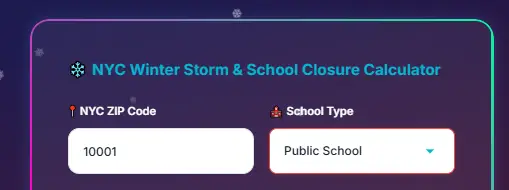
- Enter a NYC ZIP code and select the school type.
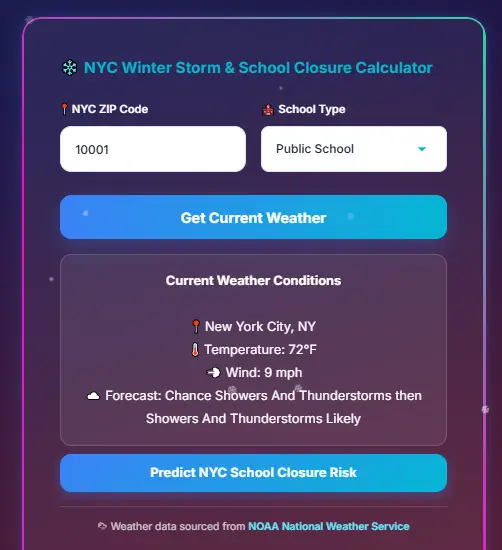
- Click Get Current Weather to retrieve live weather conditions for the selected ZIP code.
- After the weather data loads, click Predict NYC School Closure Risk to generate the school closure estimate and winter weather analysis.
- The tool converts the ZIP code into a location and retrieves current weather conditions from NOAA National Weather Service data.
- Current temperature, wind speed, and forecast conditions are analyzed automatically.
- Weather factors that typically affect school operations, including snow, ice, strong winds, and dangerous travel conditions, are assigned a weighted risk score.
- The combined score is used to estimate school closure probability, travel impact, snowfall severity, and overall winter weather risk.
The prediction model is designed to provide a quick estimate using current conditions and should be used alongside official weather forecasts and school announcements.
Will Schools Close Tomorrow in NYC?
School closures in New York City depend on more than just snowfall totals. Officials also consider subway operations, bus routes, icy sidewalks, freezing rain, and early morning road safety.
- 1–3 inches: Minor delays possible
- 3–5 inches: Increased closure potential
- 5–8 inches: High chance of disruptions
- 8+ inches: Major NYC snow day possibility
Even moderate snowstorms can create major delays in New York because of heavy traffic, crowded transit systems, and icy pedestrian conditions.
In New York City, closure decisions may also be influenced by subway operations, school bus availability, sidewalk safety, and the timing of overnight snowfall. A storm that arrives during the early morning commute can sometimes create greater disruption than a similar snowfall that occurs later in the day.
Which NYC Boroughs Receive the Most Snow?
Snowfall can vary across New York City depending on elevation, coastal influence, and storm track. Areas farther from the ocean often experience colder temperatures and slightly higher snow accumulation during winter storms.
- Bronx – Often receives slightly higher snowfall totals during major winter storms.
- Queens – Snowfall can vary significantly between coastal and inland neighborhoods.
- Brooklyn – Coastal areas may see more mixed precipitation during marginal storms.
- Manhattan – Urban heat and dense development can influence snow accumulation.
- Staten Island – Frequently records some of the highest snowfall totals within NYC.
Small temperature differences can create noticeable changes in snowfall totals between boroughs during Nor'easters and coastal winter storms.
What Happens During a NYC Snow Emergency?
When significant snowfall is expected, New York City may activate snow emergency procedures to keep roads open and public transportation operating safely.
- Emergency snow routes are cleared first.
- Parking restrictions may be temporarily enforced.
- Sanitation crews deploy plows and salt trucks.
- Bus schedules and subway service may experience delays.
- Schools and public facilities may adjust operating schedules.
Residents should monitor official city alerts during major winter storms, especially when overnight snowfall is expected.
NYC Roof Snow Weight Calculator Guide
Heavy wet snow in New York can place serious pressure on rooftops, especially during repeated winter storms or freezing rain events.
- Dry snow is lighter and fluffier
- Wet snow creates heavier roof loads
- Ice accumulation increases structural stress
- Flat rooftops in NYC may collect deeper snow buildup
Our NYC roof snow weight calculator estimate helps show when snow loads may become dangerous after large storms.
Best ZIP Codes to Track NYC Winter Weather
Weather conditions can vary across New York City during winter storms. Using a ZIP code close to your location provides the most accurate forecast and school disruption estimate.
- 10001 – Midtown Manhattan
- 10007 – Lower Manhattan
- 11201 – Downtown Brooklyn
- 11101 – Long Island City
- 10451 – Bronx
- 10301 – Staten Island
The tool automatically retrieves current weather conditions for the selected area using National Weather Service data.
How NYC Parents Prepare for Snow Days
Many New York families monitor winter forecasts closely when snowstorms are expected. School schedules, childcare arrangements, transportation plans, and commuting times can all be affected by severe weather.
- Check school notifications early in the morning.
- Monitor subway and bus service updates.
- Allow extra travel time during snowy conditions.
- Prepare for delayed openings and early dismissals.
- Watch for freezing rain and icy sidewalks.
Even when schools remain open, winter weather can significantly affect travel throughout the city.
Historical Snowstorms in New York City
New York City has experienced several major blizzards that shut down schools, airports, highways, and public transportation systems.
Some of the most memorable NYC snowstorms include:
- The Blizzard of 1888
- The 1996 East Coast Blizzard
- Winter Storm Jonas in 2016
- The December 2020 NYC Snowstorm
Many of these storms caused record snowfall totals, severe travel disruptions, school closures, and citywide emergency declarations. Historical storm records from NOAA and National Weather Service archives help provide context for how major winter weather events can impact New York City.
Explore More Winter Weather Tools
Checking winter weather conditions in other cities? Explore our local snowfall and school closure prediction tools.
How Winter Storms Affect Daily Life in New York City
Unlike many smaller cities, New York relies heavily on public transportation, walking, and dense commuter traffic. Even moderate snowfall can create significant delays across subway lines, bus routes, bridges, tunnels, and major roadways.
Many families monitor winter forecasts closely because school schedules, transit service, and commute times can change quickly during Nor’easters and major snowstorms.
Official NYC Winter Weather Resources
During significant snowstorms, Nor’easters, or blizzard warnings, official updates should always be checked before travelling or making school-related decisions.
These resources provide official weather alerts, school updates, transportation disruptions, and emergency information.
Frequently Asked Questions
How accurate is the NYC school closing predictor?
The tool provides estimated closure chances using snowfall totals, wind conditions, and road safety factors. Official decisions are still made by city officials and school districts.
How much snow usually closes schools in NYC?
School closures often become more likely once snowfall reaches around 4 to 6 inches overnight combined with dangerous travel conditions.
What causes NYC blizzard conditions?
Blizzards happen when heavy snowfall combines with strong winds and reduced visibility for several hours, creating dangerous travel conditions across the city.
Does this tool use live National Weather Service data?
Yes. The tool retrieves current weather conditions from NOAA National Weather Service data based on the ZIP code entered and uses those conditions to estimate school disruption risk and winter weather impacts.
Does wet snow create more roof stress?
Yes. Wet snow contains more moisture and weighs significantly more than dry powder snow, increasing pressure on rooftops and structures.
Can this tool track New York winter weather alerts?
The calculator estimates storm severity and snow risk, but official alerts should still be monitored through local emergency weather services.
Can I use nearby ZIP codes outside NYC?
Yes. The tool also works for nearby New York and New Jersey ZIP codes affected by the same winter storm system.