Hey There Friends, Winter weather brings beauty, but it also brings tough decisions for our school districts across Canada and the USA.
Often many parents and students wonder how snow days are decided, who makes the call, and why one town closes while another stays open. This complete guide explains the real process in simple language.
We will walk through how weather checks happen, how safety is measured, and how final closure calls are made.
By the end, our families can better understand what happens behind the scenes when winter storms hit.
Snow day decisions in Canada and USA, who actually makes the call
Do you know? In most regions, the decision is made by the school district or school board, not by a single principal. There is usually a small operations team. This team includes transportation managers, safety officers, and district leaders.
They start checking conditions very early in the morning. Often between 4 am and 5 am. In rural areas, checks can begin even earlier because bus routes are longer.
Local factors matter a lot. A city district and a rural district may look at the same snowfall but reach different choices.
That is because our road types, distance, and equipment are not the same.
In Canadian provinces, school boards often work closely with municipal road crews. In many US states, districts coordinate with county emergency offices. It is a shared safety effort.
Weather data schools review before winter closures
School officials do not just look outside and guess. They have to review several weather sources and reports.
They usually check
- National and regional weather services
- Local radar and storm tracking tools
- Road temperature reports
- Wind speed and visibility levels
In the USA, districts often rely on National Weather Service briefings; on the other hand, in Canada, they often follow Environment Canada updates plus local station forecasts.
Snowfall alone is not enough. Ice risk is often more dangerous than deep snow. Wet snow plus freezing temperatures can create black ice. That is a thin, hard to see ice layer on roads and sidewalks.
For example, let’s say Two inches of snow with ice underneath can be more hazardous than six inches of dry snow. Buses slide more easily on ice than on packed snow.
Road and bus route safety checks for school closure decisions
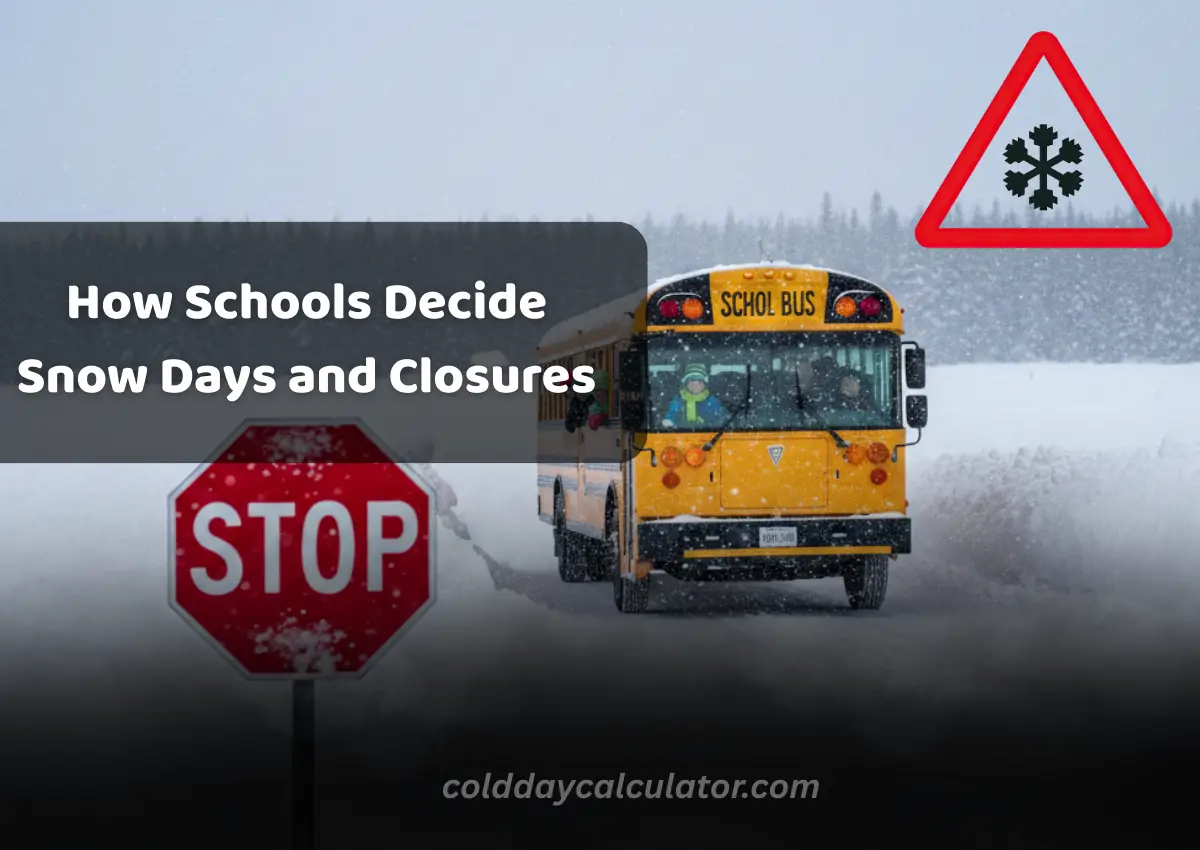
One of the biggest factors is bus route safety. If buses cannot run safely, many districts will close schools, even if buildings are open and heated.
Transportation teams often send out drivers or supervisors to test routes before sunrise. They check
- Main roads
- Back roads
- Hills and curves
- Bridges and overpasses
Bridges freeze faster than normal roads because cold air moves above and below the surface. That makes them at high risk early in the morning.
In rural Canada and northern US states, long gravel roads are a major concern. Plows may not reach them quickly. Drifting snow can also block open areas.
Like, A town road may be clear, but a country route with blowing snow may have zero visibility. If even a portion of routes are unsafe, buses may be canceled.
Temperature and wind chill rules schools follow
Extreme cold can also lead to closures or delayed starts, even without heavy snow.
Wind chill is especially important. Wind chill is how cold it feels on our skin when wind combines with low temperature. Strong wind pulls heat away from the body faster.
Many districts set a wind chill threshold. If it drops below that number, they consider canceling classes or buses.
For example,If the air temperature is minus 20 degrees, but wind makes it feel like minus 35, exposed skin can freeze in minutes. Waiting at a bus stop becomes unsafe for students.
Northern parts of Canada and states like Minnesota, North Dakota, and Alaska use these limits more often than milder regions.
School building safety during winter storms
Roads are not the only concern. School buildings must also be safe and ready.
- District teams check
- Heating system reliability
- Power outage risk
- Water pipe freeze risk
- Roof snow load
Heavy, wet snow can stress older roofs. Ice can damage power lines. If a building might lose heat or electricity, closing is often the safer choice.
Custodial teams may inspect entrances and walkways. If ice cannot be cleared in time, student slip risk increases.
Urban districts often have more maintenance staff. Smaller districts may need more time to prepare facilities after a storm.
Why nearby districts make different snow day calls
Families often ask why one district closes and another stays open nearby. It can feel confusing, but there are real reasons.
- Each district has different
- Road coverage
- Elevation levels
- Bus route lengths
- Weather impact zones
Lake effect snow is a good example in parts of the USA and Canada. Areas near large lakes can get heavy bands of snow while towns just 20 miles away get very little.
Mountain and hill regions also vary quickly with elevation.
Delayed start vs full closure, how the choice is made
Sometimes schools choose a delayed start instead of a full closure. This gives road crews more time to clear streets and parking lots.
A delayed start usually means opening one or two hours later than normal. Bus pickup times shift later too.
This option is used when
The storm is ending early morning
Roads are improving quickly
Temperatures are rising after sunrise
Full closure is more likely when snow is still falling heavily or ice risk is growing.
District leaders try to avoid last minute switches. But fast changing weather can force updates.
How families get snow closure announcements
Communication has improved a lot in recent years. Most districts now use multiple alert methods.
Common notice channels include
- Text and email alerts
- Automated phone calls
- District websites
- Local TV and radio stations
- Official social media pages
- Some smart student get alert from snow day calculator tool site
Many districts aim to announce decisions by around 6 am. Some earlier. Timing depends on storm patterns and route reports.
Families should keep contact info updated with their school. That helps ensure alerts reach us quickly.
How parents and students can prepare for winter closures
While we cannot control weather, we can prepare for winter school disruptions.
Helpful steps include
- Keep winter clothing ready the night before
- Charge phones and devices overnight
- Check district alert systems are enabled
- Have a backup child care plan
- Prepare simple home learning activities
It also helps to explain to children why closures happen. The reason is safety, not convenience. That builds understanding and patience.
Final thoughts
School snow closures in Canada and the USA follow a structured safety process. Leaders review weather reports, road tests, temperature risk, and building readiness. Transportation safety plays a major role. So does wind chill and ice danger.
Different districts can reach different choices because local conditions are not the same. That is normal and expected.
When winter storms arrive, the goal is simple. Protect students, protect staff, and avoid preventable accidents. With better understanding of the process, our families can feel more informed and less surprised when the next winter closure notice arrives.