Wind Chill Calculator
Calculate how cold it really feels outside using wind speed and temperature. Our advanced wind chill calculator helps you understand real winter risk instantly.
Used by outdoor workers, travelers, and winter planners worldwide.
What Is Wind Chill?
Wind chill refers to how cold it actually feels on our skin when wind combines with low temperature. Even if the thermometer shows a certain temperature, moving air removes heat from our body faster, making it feel significantly colder.
This happens because wind disrupts the thin layer of warm air around our skin, increasing heat loss. The stronger the wind, the faster our body loses heat — and the colder we feel.
How Wind Chill Is Calculated
Our calculator uses the official formula developed by weather agencies. It combines wind speed and air temperature to estimate perceived temperature.
The formula considers how moving air accelerates heat loss from exposed skin. While not perfect, it provides a reliable estimate used in real-world forecasts.
Temperature Input
Measures actual air temperature before wind effect.
Wind Speed
Higher wind removes heat faster from the body.
Feels Like Result
Final output shows perceived temperature.
How Does a Wind Chill Work?
Our body constantly loses heat through different processes:
- Convection (the main cause of wind chill)
- Conduction and radiation (smaller roles)
When wind blows, it removes the thin layer of warm air surrounding our skin and replaces it with colder air. The stronger the wind, the faster heat is lost.
As a result, our body has to work harder to maintain its temperature, which is why it feels much colder than what the thermometer shows.
How to Calculate Wind Chill with Formulas
Our calculator uses the official National Weather Service (USA) formula, which is widely accepted around the world.
In Fahrenheit & mph (Imperial)
Wind Chill Temperature = 35.74 + 0.6215×T − 35.75×V0.16 + 0.4275×T×V0.16
(where T = air temperature in °F, V = wind speed in mph)
In Celsius & km/h (Metric – most useful in India)
Wind Chill (°C) = 13.12 + 0.6215×T − 11.37×V0.16 + 0.3965×T×V0.16
(where T = air temperature in °C, V = wind speed in km/h)
Wind Chill Chart For Reference
Use the wind chill chart below to quickly estimate how cold it feels based on different combinations of temperature and wind speed.
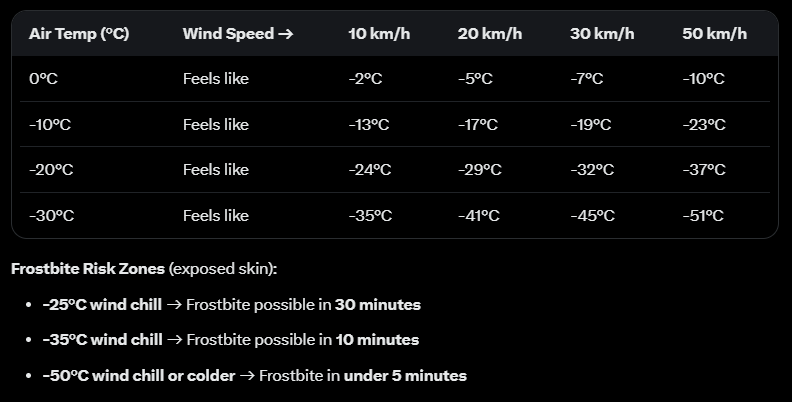
Dress Warmly & Stay Safe in Winter (Temperature Guide)
Dressing properly in cold weather is essential to prevent heat loss and protect against frostbite and hypothermia.
Always wear layered clothing, cover exposed skin, and avoid prolonged exposure in extreme wind chill conditions.
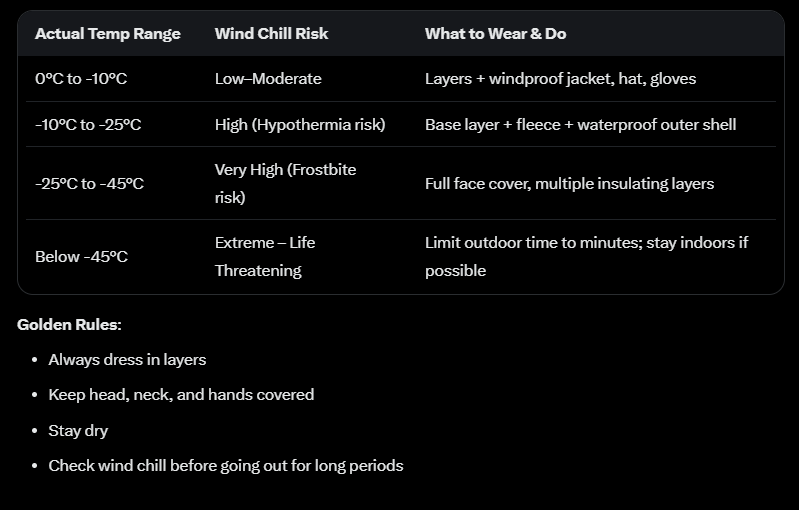
Frostbite and Hypothermia Risks
Extremely low wind chill values can be dangerous. When the body loses heat faster than it can produce, serious conditions like frostbite and hypothermia can occur.
Frostbite affects exposed skin such as fingers, toes, nose, and ears. Hypothermia impacts the entire body and can become life-threatening if untreated.
Frostbite
Skin freezes, causing numbness, discoloration, and damage.
Hypothermia
Body temperature drops below safe levels.
Prevention
Layer clothing and cover exposed skin.
Why Use Our Wind Chill Calculator?
Unlike basic weather apps, our tool focuses specifically on how cold it feels — not just raw temperature. This helps you make better decisions about outdoor safety, travel, and clothing.
Whether you're planning a trip, working outside, or preparing for winter, knowing the real feel temperature is essential.
FAQs
What is wind chill?
Wind chill is the perceived temperature felt on the body due to wind and air temperature combined.
Is wind chill accurate?
It is a scientific estimate used by weather agencies, but actual perception may vary slightly.
When is wind chill dangerous?
Below -15°C, frostbite risk increases. Extreme values can cause serious health issues.
Does humidity affect wind chill?
Humidity has a small effect, but wind speed and temperature are the main factors.
What is the difference between wind chill and actual temperature?
Actual temperature measures the air, while wind chill represents how cold it feels on our skin due to heat loss caused by wind. The air temperature remains unchanged.
Does wind chill affect cars, pipes, or pets?
Wind chill mainly affects living tissue. Cars and pipes cool based on actual air temperature, but pets can be affected because their bodies lose heat similarly to humans.
Can frostbite happen above freezing temperatures?
Yes. Even above 0°C, strong wind can increase heat loss enough to cause frostbite over extended exposure, especially on uncovered skin.
What wind chill is dangerous for kids or elderly?
Wind chill below -10°C can be uncomfortable, while below -15°C becomes risky. Children and elderly individuals are more vulnerable due to lower heat retention.
How accurate is the wind chill formula?
The formula is based on scientific models and widely used by weather agencies. While it provides reliable estimates, actual human perception may vary slightly.
Is the wind chill formula the same worldwide?
Most countries use the US or Canadian wind chill formula. However, small variations may exist depending on regional weather standards.