Boston School Closing Predictor
Track Boston winter weather conditions, Nor’easter forecasts, snowfall totals, and estimated school closure risks across Greater Boston and surrounding communities.
School Closure Analysis
Boston School Closing Predictor & Winter Storm Forecast
Boston winters often bring a mix of heavy snow, freezing rain, strong coastal winds, and powerful Nor’easters that can disrupt schools across the city and surrounding Massachusetts communities. This tool helps estimate school closure risks using live weather conditions and forecast information.
Enter a Boston ZIP code, retrieve current weather conditions, and generate a school closure prediction based on snowfall potential, temperatures, wind speed, and winter travel conditions. The calculator also provides snowfall estimates, travel risk ratings, and storm severity analysis.
Unlike many inland cities, Boston is heavily influenced by Atlantic coastal weather systems. Winter storms can strengthen rapidly as they move north along the East Coast, producing heavy snowfall, icy roads, and dangerous commuting conditions throughout Greater Boston.
School closure decisions are often influenced by road conditions, public transportation reliability, overnight snowfall accumulation, visibility, and the timing of winter storms. A storm arriving before the morning commute can have a much greater impact than a similar snowfall later in the day.
Whether you live in Back Bay, South Boston, Dorchester, Charlestown, Roxbury, Cambridge, Brookline, Quincy, Somerville, or nearby Massachusetts communities, this tool provides a quick way to evaluate winter weather risks before the next school day.
While no prediction tool can guarantee official school closure decisions, many parents, students, teachers, and commuters use winter forecasts to prepare for delays, remote learning days, transportation disruptions, and changing weather conditions.
How the Boston School Closing Predictor Works
This tool combines live weather data with a custom winter weather scoring model to estimate potential school closure risks throughout Boston and nearby Massachusetts communities.
- Enter a Boston ZIP code and select the school type.
- Click Get Current Weather to retrieve live weather conditions.
- Click Predict Boston School Closure Risk to generate the weather analysis.
- The tool converts the ZIP code into a geographic location.
- Current temperature, wind speed, and weather forecast information are retrieved from NOAA weather services.
- Weather conditions that commonly affect schools in Boston are analyzed automatically.
- Snowfall, freezing rain, strong winds, icy roads, poor visibility, and Nor’easter conditions increase the disruption score.
- The final score estimates closure probability, travel risks, snowfall severity, and storm impacts.
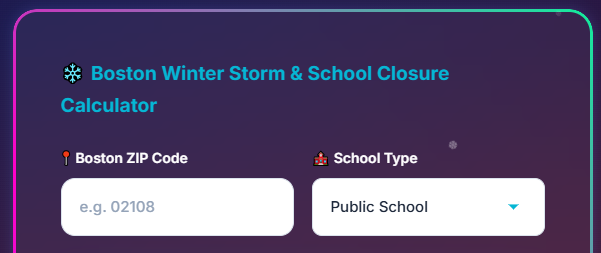
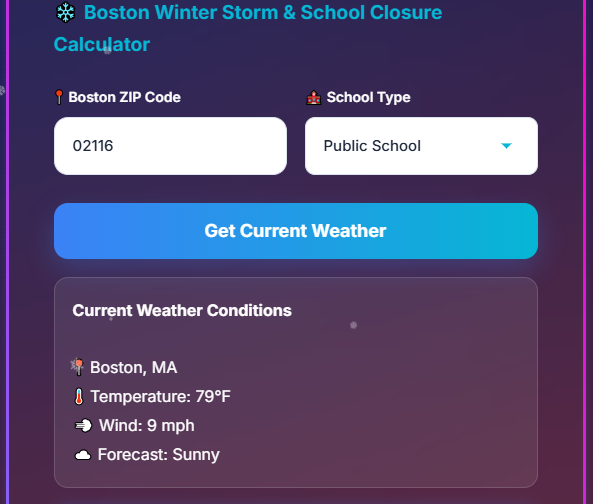
The prediction model is designed to provide an estimate only and should always be used alongside official school announcements and weather alerts.
Will Schools Close Tomorrow in Boston?
School closure decisions in Boston depend on several weather-related factors. Snowfall totals are important, but officials also evaluate road conditions, ice accumulation, visibility, public transportation reliability, and overall travel safety before making decisions.
- 1–3 inches of snow: Minor delays possible
- 3–5 inches of snow: Increased chance of delayed openings
- 5–8 inches of snow: Higher risk of school disruptions
- 8–12 inches of snow: Strong possibility of closures
- 12+ inches of snow: Major winter storm conditions
Boston schools may also experience delays or closures during freezing rain events, coastal storms, and extreme cold conditions even when snowfall amounts remain relatively low.
Because many students rely on buses, commuter rail services, and public transportation, travel conditions often play a major role in closure decisions.
Understanding Nor’easters in Boston
Nor’easters are among the most powerful winter storms that affect New England. These storms form along the Atlantic Coast and often bring heavy snow, strong winds, coastal flooding, and dangerous travel conditions throughout Massachusetts.
Unlike ordinary snowstorms, Nor’easters can intensify rapidly and impact the Boston area for many hours or even multiple days.
- Heavy snowfall rates can exceed 1–3 inches per hour.
- Strong winds may create blowing snow and reduced visibility.
- Coastal flooding can affect low-lying neighborhoods.
- Travel conditions may become dangerous throughout Greater Boston.
- Public transportation systems often experience delays.
- School closures become more likely during significant Nor’easter events.
Many of Boston's largest historical snowstorms were caused by Nor’easters moving northward along the Atlantic coastline.
How Winter Weather Affects MBTA Transportation
The Massachusetts Bay Transportation Authority (MBTA) plays a critical role in daily travel throughout Boston. Severe winter weather can affect subway lines, commuter rail schedules, buses, and station accessibility.
- Snow and ice can slow train operations.
- Strong winds may impact above-ground rail service.
- Bus routes can experience delays due to road conditions.
- Snow-covered platforms may require additional safety measures.
- Commuter rail schedules can be adjusted during major storms.
- Morning travel disruptions often influence school decisions.
Because thousands of students and staff rely on public transportation each day, MBTA service reliability is an important factor during winter weather events.
Boston Snow Emergency Procedures
When major winter storms are expected, the City of Boston may declare a snow emergency to improve public safety and keep major roadways open.
- Snow emergency routes receive priority plowing.
- Temporary parking restrictions may be activated.
- Public works crews deploy snowplows and salt trucks.
- Travel advisories may be issued.
- Public transportation schedules may be adjusted.
- Schools and public facilities may modify operations.
Boston's snow emergency system is designed to reduce congestion and improve emergency access during severe winter weather.
Residents should monitor official city alerts whenever significant snowfall or Nor’easter activity is forecast.
Why Coastal Weather Creates Unique Challenges for Boston
Boston's location along the Atlantic Ocean creates weather conditions that differ from many inland cities. Coastal storms can bring a combination of snow, sleet, freezing rain, and strong winds within a short period of time.
- Ocean moisture can increase snowfall totals.
- Temperature changes may cause snow-to-rain transitions.
- Strong coastal winds can reduce visibility.
- Wet snow often creates heavier travel impacts.
- Storm tracks can dramatically change local forecasts.
These unique weather patterns make Boston one of the most closely monitored winter weather markets in the northeastern United States.
Snow Removal Boston
Snow removal is an important part of winter life in Boston. Heavy snow, freezing rain, and Nor’easters can quickly create hazardous conditions on sidewalks, driveways, parking lots, and business properties. Property owners are often responsible for maintaining safe access during and after winter storms.
Residential Snow Removal Boston
| Service | Purpose | Typical Cost Range |
|---|---|---|
| Driveway Clearing | Removes snow buildup to restore vehicle access. | $30–$80 per visit |
| Sidewalk Shoveling | Improves pedestrian safety around homes. | $20–$60 per visit |
| Ice Treatment | Reduces slipping hazards using salt or de-icing products. | $25–$75 per treatment |
| Snow Blowing | Efficient removal of moderate snowfall accumulations. | $40–$100 per visit |
| Roof Snow Clearing | Helps prevent excessive snow buildup on residential roofs. | $150–$600 per service |
Commercial Snow Removal Boston
| Service | Purpose | Typical Cost Range |
|---|---|---|
| Parking Lot Plowing | Keeps business locations accessible during winter storms. | $150–$1,000+ per visit |
| Walkway Clearing | Improves customer and employee safety. | $50–$300 per visit |
| De-Icing Services | Reduces ice accumulation on commercial properties. | $100–$500 per application |
| Snow Hauling | Removes large snow piles from business locations. | $300–$3,000+ per project |
| Storm Monitoring | Provides ongoing snow management during severe weather. | $100–$500+ monthly |
Snow removal costs in Boston vary depending on snowfall depth, property size, accessibility, storm severity, and contractor availability. Prices shown above are general estimates and may differ between providers.
Many residential and commercial property owners arrange snow removal services before winter begins to ensure faster response during major storms. Booking services in advance is often more affordable than requesting emergency snow removal after a major Nor’easter.
Things to Do in Boston on a Cold Day
Cold winter days do not mean you need to stay indoors all day. Boston offers many attractions, museums, and activities that are ideal during snowy or freezing weather.
- Visit the Museum of Science.
- Explore the New England Aquarium.
- Tour the Museum of Fine Arts.
- Spend time at Faneuil Hall Marketplace.
- Visit the Boston Tea Party Ships & Museum.
- Enjoy indoor dining in the North End.
- Watch a Bruins or Celtics game.
- Explore Harvard Square in nearby Cambridge.
- Relax at local cafés and bookstores.
- Visit indoor observation areas and historic attractions.
Many Boston residents use snow days as an opportunity to explore museums, cultural attractions, local restaurants, and indoor entertainment venues throughout the city.
Popular Boston ZIP Codes for Winter Weather Tracking
Using a ZIP code close to your location helps generate more accurate weather conditions and school closure predictions.
- 02108 – Downtown Boston
- 02109 – Waterfront
- 02110 – Financial District
- 02111 – Chinatown
- 02113 – North End
- 02114 – Beacon Hill
- 02115 – Fenway
- 02116 – Back Bay
- 02118 – South End
- 02119 – Roxbury
- 02215 – Fenway–Kenmore
Weather conditions can vary across Greater Boston during coastal storms, making location-specific forecasts especially important.
Historic Boston Winter Storms
Boston has experienced numerous major winter storms throughout its history. Several of these events produced record snowfall totals, transportation shutdowns, and widespread school closures.
The Blizzard of 1978
One of the most famous winter storms in New England history, the Blizzard of 1978 produced extreme snowfall, strong winds, and widespread disruption throughout Massachusetts.
The January 2015 Snowstorms
A series of powerful storms during early 2015 delivered historic snowfall totals across Boston and surrounding communities.
The February 2013 Nor’easter
This major coastal storm brought heavy snowfall, blizzard conditions, and widespread travel disruptions throughout the region.
Recent Winter Storm Events
Modern Nor’easters continue to create significant challenges for schools, transportation systems, businesses, and residents throughout Greater Boston.
Boston Snow: How Many Inches Does Boston Get?
Many visitors and residents ask, "How many inches of snow does Boston get each year?" While snowfall varies significantly from season to season, Boston typically receives around 40–50 inches of snow annually. Some winters bring only moderate snowfall, while others produce multiple major Nor’easters and record-breaking snow totals.
Snowfall can accumulate quickly during coastal storms, especially when cold Arctic air combines with Atlantic moisture. The result is often heavy snowfall that affects schools, transportation systems, businesses, and daily commuting throughout Greater Boston.
Boston Snow Total Record (Recent Years)
| Winter Season | Total Snowfall | Winter Rating |
|---|---|---|
| 2014–2015 | 110.6 inches | Record Breaking |
| 2017–2018 | 59.9 inches | Heavy Snow Season |
| 2021–2022 | 54.4 inches | Above Average |
| 2013–2014 | 58.6 inches | Heavy Snow Season |
| 2018–2019 | 34.3 inches | Near Average |
| 2019–2020 | 21.8 inches | Below Average |
| 2020–2021 | 38.9 inches | Moderate Snowfall |
| 2022–2023 | 12.3 inches | Very Low Snowfall |
| 2015–2016 | 36.1 inches | Moderate Snowfall |
| 2016–2017 | 43.8 inches | Near Average |
The winter of 2014–2015 remains one of the snowiest seasons in Boston history, with more than 110 inches of snowfall recorded. Multiple Nor’easters caused repeated school closures, MBTA disruptions, and widespread snow removal challenges throughout the city.
Because snowfall varies dramatically from year to year, Boston residents closely monitor winter forecasts whenever major coastal storms are expected. Even a single Nor’easter can significantly increase seasonal snowfall totals within just a few days.
Boston Winter Weather Facts
Boston's climate creates a wide variety of winter weather conditions each year. Coastal influences and Atlantic storm systems often produce rapid changes in temperature and precipitation.
- Boston averages significant snowfall during a typical winter season.
- Nor’easters are among the region's most impactful weather events.
- Freezing rain can create dangerous travel conditions.
- Strong coastal winds often accompany major storms.
- Snowfall totals can vary greatly between neighborhoods.
- Winter weather frequently affects transportation schedules.
Official Boston Winter Weather Resources
Always verify weather alerts, transportation updates, and school announcements through official sources before making decisions during severe weather.
- National Weather Service
- City of Boston
- MBTA Service Alerts
- Commonwealth of Massachusetts
- Boston Public Schools
These resources provide official weather warnings, transportation information, emergency alerts, and school-related updates.
Frequently Asked Questions
How accurate is the Boston School Closing Predictor?
The tool provides estimated school closure probabilities using snowfall forecasts, temperature, wind conditions, travel risks, and winter weather factors. Official closure decisions are made by school districts and local authorities.
What is a Nor’easter?
A Nor’easter is a powerful storm that develops along the Atlantic Coast and can bring heavy snow, strong winds, coastal flooding, and severe travel disruptions across New England.
How much snow usually causes school closures in Boston?
School closures become more likely when snowfall exceeds 5 to 8 inches overnight, especially when combined with icy roads, poor visibility, and transportation disruptions.
Can schools close because of freezing rain?
Yes. Freezing rain can create extremely dangerous road and sidewalk conditions, sometimes causing delays or closures even when snowfall totals remain low.
Does this tool use live weather data?
Yes. The calculator retrieves current weather information from NOAA National Weather Service sources based on the ZIP code entered.
Does MBTA service affect school closures?
Public transportation reliability can influence closure decisions because many students, teachers, and staff rely on MBTA services for daily travel.
Can I use ZIP codes outside Boston?
Yes. The tool works for many nearby Massachusetts communities affected by the same winter weather systems.
Should I rely solely on this prediction?
No. Always check official school announcements, weather warnings, and local emergency updates before making decisions.