Chicago School Closing Predictor
Check current Chicago winter weather conditions, snowfall forecasts, and estimated school closure risks across the city and surrounding Cook County communities.
School Closure Analysis
Chicago School Closing Predictor & Winter Storm Forecast
Chicago winters can bring heavy snowfall, freezing temperatures, strong winds, lake-effect snow, and dangerous road conditions that may impact schools throughout the city. This tool helps estimate potential school closure risks using current weather conditions and forecast information.
Simply enter a Chicago ZIP code, retrieve live weather data, and generate a school closure prediction based on snowfall potential, temperature, wind speed, and travel safety conditions. The calculator also provides snowfall estimates, roof snow load calculations, and overall winter storm impact ratings.
While no prediction tool can guarantee whether schools will officially close, this calculator can help parents, students, teachers, and commuters better understand how severe winter weather may affect the next school day.
Chicago is known for rapid weather changes and strong winter storms influenced by Lake Michigan. Even moderate snowfall combined with icy roads and high winds can create significant travel disruptions throughout the city. Monitoring weather conditions early can help families prepare for possible delays, closures, or schedule changes.
Whether you live in Downtown Chicago, Lincoln Park, Hyde Park, Wicker Park, Logan Square, Bridgeport, or nearby Cook County communities, this school closure predictor offers a quick and easy way to evaluate winter weather risks before heading out.
How the Chicago School Closing Predictor Works
This tool combines live weather data with a custom winter weather scoring system to estimate potential school closure risks across Chicago and surrounding Cook County communities.
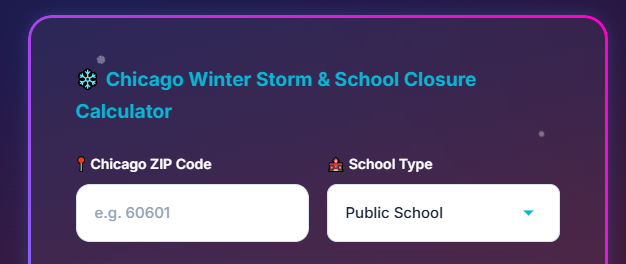
- Enter a Chicago ZIP code and select your school type.
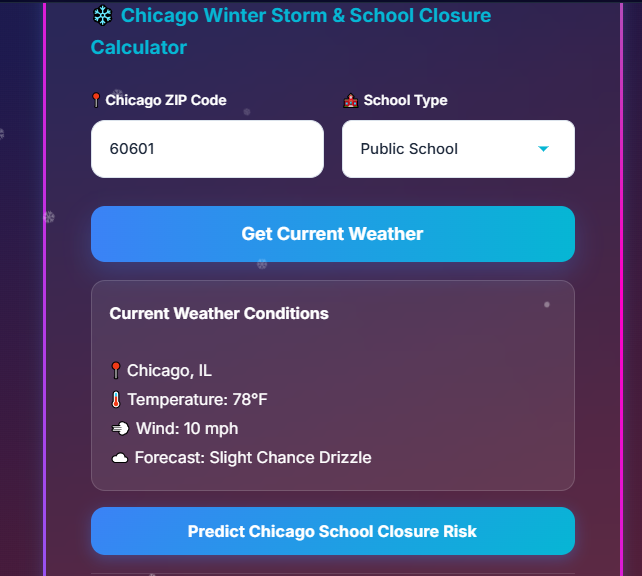
- Click Get Current Weather to retrieve live weather conditions for your location.
- Click Predict Chicago School Closure Risk to generate your school closure estimate.
- The tool converts your ZIP code into geographic coordinates.
- Current temperature, wind speed, snowfall conditions, and forecast data are retrieved from NOAA weather services.
- Weather factors that commonly disrupt schools in Chicago are analyzed automatically.
- Heavy snow, freezing rain, ice accumulation, lake-effect snow, and dangerous travel conditions increase the risk score.
- The final score estimates closure probability, travel safety concerns, snowfall impact, and roof snow load risk.
The calculator is designed to provide a helpful estimate and should always be used alongside official school district announcements and weather alerts.
Will Schools Close Tomorrow in Chicago?
School closure decisions in Chicago are influenced by several weather-related factors beyond snowfall totals alone. School administrators and local authorities consider road safety, wind chill values, public transportation reliability, and overall travel conditions before deciding whether schools should remain open.
- 1–3 inches of snow: Minor delays possible
- 3–5 inches of snow: Increased risk of delayed starts
- 5–8 inches of snow: Higher chance of school disruptions
- 8–12 inches of snow: Significant closure potential
- 12+ inches of snow: Major winter storm with high closure risk
Chicago schools may also close during extreme cold events even when snowfall is limited. Dangerous wind chills, icy roads, and reduced visibility can create safety concerns for students and staff.
Lake-effect snow can create highly localized weather conditions where one neighborhood receives significantly more snow than another. This can lead to varying travel conditions across different parts of the city.
How Lake Michigan Affects Chicago Snowfall
Chicago's location along Lake Michigan creates unique winter weather patterns that can dramatically increase snowfall totals during certain storm systems.
Cold air moving across the relatively warmer waters of Lake Michigan can produce lake-effect snow bands that generate intense snowfall rates in specific areas.
- Lakefront neighborhoods may experience rapidly changing weather conditions.
- Snowfall totals can vary greatly within short distances.
- Visibility can drop quickly during lake-effect snow events.
- Road conditions may deteriorate much faster than regional forecasts suggest.
- School transportation routes can become hazardous during intense snow bands.
Lake-effect snow remains one of the most important winter weather factors affecting travel and school operations throughout the Chicago metropolitan area.
Chicago Snow Emergency Procedures
When major winter storms are forecast, Chicago officials may activate snow emergency operations to maintain road safety and keep critical transportation routes open.
- Snow routes receive priority plowing and treatment.
- Salt trucks are deployed throughout the city.
- Emergency parking restrictions may be enforced.
- Public transit schedules may be adjusted.
- Airport operations at O'Hare and Midway may experience delays.
- Schools and public facilities may modify schedules.
Residents should monitor local weather alerts and emergency announcements whenever significant winter weather is expected.
The city maintains an extensive snow removal operation, but heavy snowfall combined with strong winds can still create dangerous travel conditions across Chicago.
Chicago Roof Snow Weight Calculator Guide
Heavy snowfall can place significant stress on residential, commercial, and industrial rooftops throughout Chicago during winter storms.
Repeated snow events without melting periods can lead to snow accumulation that increases structural loading on buildings.
- Dry powder snow is relatively light.
- Wet snow contains more moisture and weighs substantially more.
- Freezing rain and ice buildup add significant weight.
- Flat commercial roofs often collect deeper accumulations.
- Drifting snow can create uneven roof loading.
The roof snow load estimate provided by this calculator helps visualize how winter storms may impact structures after heavy snowfall events.
Property owners should monitor roof conditions carefully during prolonged winter storms, especially when snowfall is followed by freezing rain or additional snow accumulation.
Chicago Winter Travel Conditions
Winter weather affects nearly every aspect of transportation across Chicago. Snow, ice, freezing rain, and strong winds can quickly create hazardous travel conditions during the morning commute.
- Reduced visibility during snow squalls.
- Snow-covered highways and city streets.
- Bridge and overpass icing.
- CTA bus delays and route disruptions.
- Train schedule interruptions.
- Airport delays at O'Hare and Midway.
Even moderate snowfall can cause widespread transportation issues due to heavy traffic volumes and densely populated neighborhoods throughout the city.
Best Chicago ZIP Codes to Track Winter Weather
Weather conditions can vary significantly across Chicago during winter storms. Using a ZIP code close to your actual location helps generate the most accurate school closure prediction and snowfall estimate.
- 60601 – The Loop
- 60605 – South Loop
- 60610 – Near North Side
- 60614 – Lincoln Park
- 60616 – Chinatown & Near South Side
- 60622 – Wicker Park
- 60625 – Lincoln Square
- 60640 – Uptown
- 60647 – Logan Square
- 60657 – Lakeview
The tool automatically retrieves weather information for the selected ZIP code and applies Chicago-specific winter weather analysis to estimate school closure risk.
How Chicago Parents Prepare for Snow Days
Chicago families often begin monitoring weather forecasts several days before a major winter storm arrives. School schedules, childcare arrangements, transportation plans, and work commutes can all be affected by severe weather.
- Monitor weather forecasts throughout the evening.
- Check school district announcements early in the morning.
- Prepare alternate transportation plans.
- Allow extra travel time during snowy conditions.
- Keep emergency winter supplies available.
- Charge mobile devices before storms arrive.
- Watch for delayed openings and early dismissals.
- Monitor wind chill advisories and extreme cold warnings.
Many Chicago-area school districts announce weather-related decisions early in the morning, especially when overnight snowfall creates dangerous travel conditions.
Historical Chicago Blizzards and Major Snowstorms
Chicago has experienced some of the most memorable winter storms in the United States. These events caused widespread travel disruptions, airport shutdowns, school closures, and dangerous conditions throughout the region.
The Great Chicago Blizzard of 1967
The January 1967 blizzard remains one of Chicago's most famous winter storms. More than 23 inches of snow fell across parts of the city, creating massive transportation disruptions and bringing daily life to a standstill.
The Blizzard of 1979
This storm produced heavy snowfall, strong winds, and severe travel conditions. Large portions of the city experienced prolonged disruptions and emergency snow removal operations.
The Groundhog Day Blizzard of 2011
One of the largest modern snowstorms to impact Chicago, this event produced snowfall totals exceeding 20 inches in some locations. Schools, businesses, and transportation systems experienced widespread closures.
Recent Winter Storm Events
Chicago continues to experience significant winter storms that can bring heavy snow, freezing rain, dangerous wind chills, and travel disruptions. These events highlight the importance of monitoring weather conditions throughout the winter season.
Chicago Winter Weather Facts
Chicago is well known for its cold winters, strong winds, and frequent snowfall events. The city's location near Lake Michigan plays a major role in shaping local weather patterns.
- Average annual snowfall exceeds 35 inches in many years.
- January is typically the coldest month.
- Wind chills can occasionally fall below -20°F.
- Lake-effect snow can increase local snowfall totals.
- Winter storms often impact transportation and school operations.
- Snowfall totals can vary dramatically between neighborhoods.
Because winter weather can change rapidly, families should always stay informed through trusted forecast sources and local alerts.
How Winter Weather Impacts Chicago Commuters
Millions of people travel throughout Chicago every day using roads, buses, trains, and public transportation systems. Severe winter weather can significantly increase commute times and create hazardous travel conditions.
- Snow-covered roads reduce traffic speeds.
- Strong winds can lower visibility.
- CTA bus routes may experience delays.
- Metra schedules may be affected during major storms.
- Airport operations can experience cancellations and delays.
- Pedestrian travel becomes more dangerous due to ice.
Even when schools remain open, transportation delays can affect students, parents, and school staff throughout the Chicago metropolitan area.
Explore More Winter Weather Tools
Looking for school closure predictions and snowfall estimates in other cities? Explore additional winter weather calculators below.
Official Chicago Winter Weather Resources
Always verify weather alerts, school announcements, and travel conditions through official sources before making decisions during severe winter weather.
- National Weather Service
- City of Chicago
- Chicago Public Schools
- Chicago Transit Authority
- State of Illinois
These resources provide official weather warnings, transportation updates, emergency notifications, and school-related announcements.
Chicago School Closings, Snow Days, and Winter Storm Forecasts
Winter weather can affect daily life throughout Chicago in many ways. Heavy snowfall, freezing rain, ice accumulation, and strong winds all have the potential to create hazardous travel conditions that may impact schools, businesses, and transportation systems. Because Chicago experiences a wide range of winter weather events each year, many families search for school closing information whenever major storms are forecast.
This Chicago School Closing Predictor helps provide an estimate of potential school disruption risks by analyzing live weather conditions. The tool is designed for parents, students, teachers, commuters, and anyone who wants a quick understanding of how winter weather may affect school operations.
Although official school closure decisions depend on many factors, weather remains one of the most important influences. Snowfall intensity, overnight accumulation, road conditions, visibility, wind chill values, and ice formation can all contribute to decisions made by school districts and local authorities.
By combining weather information with winter storm analysis, this tool offers a convenient way to evaluate potential risks before the next school day. Users can enter their local ZIP code, retrieve current weather conditions, and receive an estimated closure probability based on winter weather severity.
Frequently Asked Questions
How accurate is the Chicago School Closing Predictor?
The tool provides estimated closure probabilities based on current weather conditions, snowfall forecasts, temperature, wind speed, and winter travel risks. Official school closure decisions are always made by school districts and local authorities.
How much snow typically causes school closures in Chicago?
While every situation is different, closures become more likely when snowfall exceeds 5 to 8 inches overnight or when dangerous road conditions and extreme wind chills are expected.
Does lake-effect snow affect school closure predictions?
Yes. Lake-effect snow can rapidly increase snowfall totals and create hazardous travel conditions in localized areas near Lake Michigan.
Can schools close because of extreme cold?
Yes. Dangerous wind chill values, especially below -20°F, can sometimes lead to school closures or delayed starts even when snowfall is limited.
Does this calculator use live weather data?
Yes. The tool retrieves current weather conditions from NOAA National Weather Service data and uses those conditions to estimate school disruption risks.
What factors increase school closure risk?
Heavy snow, freezing rain, blizzard conditions, strong winds, icy roads, poor visibility, and dangerous wind chills all contribute to higher closure probabilities.
Can I use ZIP codes outside Chicago?
Yes. The calculator works for surrounding Cook County communities and nearby Illinois ZIP codes supported by the weather data system.
Should I rely solely on this predictor?
No. Always monitor official school announcements, weather alerts, and emergency information before making travel or scheduling decisions.