Free Commercial Snow Removal Pricing Calculator
Estimate accurate commercial snow removal costs using real industry data. Calculate snow plowing rates, seasonal contracts, and per visit pricing instantly and free.
Enter Property Details
What is Commercial Snow Removal Pricing Calculator?
Our Free Commercial Snow Removal Pricing Calculator helps estimate accurate costs for snow plowing services based on real market data. Commercial snow plowing rates typically range between $50 to $200 per hour, while seasonal contracts can range from $3,000 to $18,000+ depending on property size and complexity.
Instead of guessing, our snow removal cost calculator uses property size, snowfall, and service type to generate realistic estimates.
How Does Our Snow Removal Cost Calculator Work?
Step 1: Enter Property Size and Snowfall
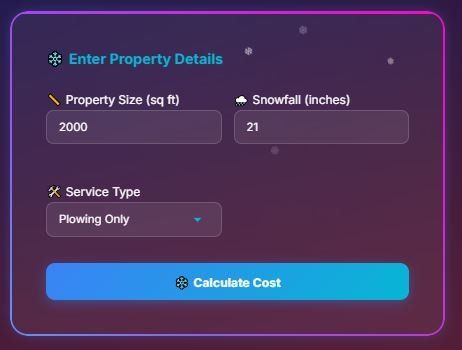
You enter property size and snowfall
Step 2: Select Service Type

Select service type (plowing, salting, full service)
Step 3: Click on Calculate Cost Button
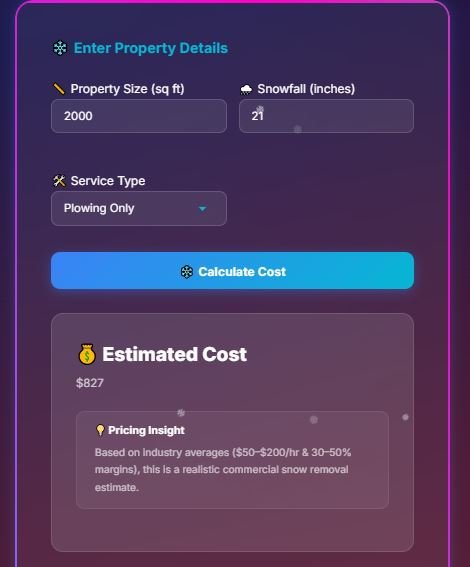
Tool calculates cost using industry rates
Step 4: Include Labor and Material Cost
Includes labor ($25–$75/hr) and material cost
Step 5: Apply Overhead and Profit Margin
Applies average overhead (40–50%) and profit margin
How the Calculator Builds Your Estimate
Our calculator translates the same inputs a commercial snow removal contractor uses when building a bid into an instant estimate. Start by entering your property's square footage, this determines how long a crew will need on site, since larger lots require more passes and more equipment time regardless of how deep the snow is. Next, enter expected snowfall in inches; deeper accumulation slows down plowing, often requires multiple passes over the same area, and increases the odds that salting or sidewalk clearing gets added to the job. Finally, choose your service type. Plowing-only reflects a bare-minimum lot clearing job, while Plowing + Salting adds material and application costs, and Full Service layers in sidewalk and entrance clearing the most labor-intensive and highest-liability part of any commercial contract.
Behind the scenes, the calculator applies the same cost structure real contractors use: a base labor and equipment rate per square foot, scaled up by a snowfall-depth multiplier (since more snow means more time on site), then multiplied by your selected service tier. That subtotal represents the contractor's actual cost to complete the job. We then apply an industry-standard profit margin to that cost the same cost-plus pricing model taught by trade platforms like Jobber, Housecall Pro, and Aspire, and consistent with the cost-tracking framework published by the Snow & Ice Management Association (SIMA) to arrive at a realistic market price, not just a raw cost estimate.
The result is a number that reflects what a properly-insured, professionally-run snow removal company would actually need to charge to cover labor, materials, overhead, and a sustainable profit margin, not a rough guess.
What Your Result Means
The result reflects real-world commercial snow removal pricing used by contractors.
Key Factors That Affect Snow Removal Pricing
- Property size — Larger lots require more time, more passes, and often more than one truck. Contractors typically price by square footage or acreage rather than a flat fee, since a 10,000 sq ft lot and a 100,000 sq ft lot are fundamentally different jobs.
- Snowfall depth and frequency — Storms that exceed 6–8 inches typically require multiple passes over the same area, which is why most calculators and contractor bids apply a depth-based multiplier rather than a flat per-inch rate. Frequency matters too: a region with 10+ storms per season has different economics than one with 3.
- Trigger depth — Most commercial contracts specify a snowfall depth (commonly 2–3 inches) that automatically triggers a plow visit. A lower trigger depth means more visits and a higher overall seasonal cost.
- Service type and scope — Plowing-only, plowing + salting, and full-service (plowing + salting + sidewalk/entrance clearing) are priced as distinct tiers because each adds labor, materials, and liability exposure.
- Labor cost — Snow crews typically earn $25–$75 per hour per worker, with rates pushed higher during overnight storms, back-to-back events, or hazard conditions.
- Material usage — Rock salt runs roughly $150–$350 per acre per application, with 500–1,000 lbs typically applied per acre depending on temperature and ice severity. Eco-friendly or liquid de-icers cost more per application but reduce corrosion and environmental impact.
- Site accessibility and complexity — Lots with tight turns, multiple entrances, curbing, islands, or heavy pedestrian traffic take longer to clear safely and typically carry a complexity premium.
- Overhead costs — Insurance, fuel, equipment maintenance, dispatch software, and administrative costs typically represent 40%–50% of a contractor's total operating cost, and are baked into every legitimate quote.
- Region and local competition — Snowbelt regions with frequent storms often see lower per-visit pricing (since revenue is spread across more events), while areas with occasional snow tend to have higher per-visit rates to make the season worthwhile for contractors.
- Liability and insurance requirements — Commercial properties carry higher slip-and-fall liability than residential ones, especially near entrances, which is factored directly into sidewalk-clearing and full-service pricing.
Snow Removal Pricing Models: Which One Fits Your Property?
Commercial snow removal isn't priced one single way — contractors typically offer four different models, and the right one depends on your region, snowfall pattern, and risk tolerance.
Hourly billing works best for smaller lots or one-off storms. You pay for actual time on site, usually $25–$75 per hour for a single operator, though larger commercial equipment runs $50–$200 per hour. It's transparent, but unpredictable in a heavy winter.
Per-push (per-visit) pricing charges a flat fee every time your property is plowed, typically triggered once snowfall hits a set depth — usually 2 to 3 inches. This "trigger depth" is standard across the industry and protects you from paying for visits you didn't need. Per-push rates run roughly $150–$500 for commercial lots, scaling up to $900+ for large or complex properties.
Per-inch pricing scales the cost with snowfall depth rather than charging a flat fee per visit — useful in regions where storms vary wildly in severity from one event to the next.
Seasonal contracts lock in one flat price for the entire winter (typically November through April), regardless of how many storms hit. This shifts weather risk from you to the contractor. It's the most common choice for corporate campuses, medical facilities, retail centers, and any property where budget certainty matters more than paying the lowest possible price in a mild winter. Commercial seasonal contracts generally range from $2,000 to $18,000+, driven almost entirely by lot size and historical snowfall averages for your region.
As a rule of thumb: properties in snowbelt regions with frequent, predictable storms tend to save with seasonal contracts, while properties in areas with occasional, unpredictable snow often come out ahead with per-push pricing.
Average Commercial Snow Removal Costs (2026)
Based on current market data, here's what commercial properties are actually paying across the most common pricing structures:
| Service | Cost Range | Best For |
|---|---|---|
| Hourly Rate | $50 – $200/hr | Small lots, one-off jobs, ad hoc requests |
| Per Visit / Per Push | $150 – $500 (up to $900+ for large lots) | Unpredictable snowfall regions, flexible budgets |
| Per Push (Large/Complex Lots) | $200 – $900+ | Large parking lots, retail centers, multi-entrance sites |
| Seasonal Contract | $2,000 – $18,000+ | Snowbelt regions, budget-certainty properties (hospitals, campuses) |
| Salt Application | $150 – $350 per acre | Any lot requiring ice management alongside plowing |
| Sidewalk Clearing | $35 – $100/hr | Entrances, walkways, liability-sensitive areas |
| Snow Hauling | $200 – $800 per truckload | Properties with limited on-site snow storage |
| Roof Snow Removal | $300 – $1,500 per job | After major accumulation events, structural risk mitigation |
Where you land in these ranges depends primarily on property size, local snowfall averages, and how much of the "full service" bundle (salting, sidewalks, hauling) is included versus billed separately. A 10,000 sq ft strip mall lot and a 250,000 sq ft distribution center lot will land at opposite ends of the seasonal contract range even in the same city.
What's Typically Included in a Commercial Snow Removal Contract
A commercial quote is rarely just "plowing." Full-service contracts usually bundle several line items, and knowing what's typically included helps you compare quotes accurately.
- Lot plowing — clearing drive lanes and parking areas, usually triggered at 2–3 inches of accumulation.
- Salting / de-icing — rock salt applications run $150–$350 per acre, with liquid or eco-friendly de-icers priced at a premium. Standard application rates are roughly 500–1,000 lbs of salt per acre, depending on temperature and ice conditions.
- Sidewalk and entrance clearing — billed separately at $35–$100 per hour, since it's hand labor and carries higher liability exposure (slip-and-fall risk near entrances is a major driver of this cost).
- Snow hauling and relocation — needed when on-site snow storage fills up; typically $200–$800 per truckload including labor and disposal.
- Roof snow removal — a specialized, higher-risk service priced separately at $300–$1,500 per job, usually only needed after major accumulation events.
- Liability insurance and response guarantees — reputable commercial contractors carry general liability coverage and specify guaranteed response times (e.g., service must begin within 2 hours of trigger depth being reached). Always confirm this is included before signing.
When comparing bids, ask exactly which of these are bundled into the seasonal or per-push rate versus billed as add-ons — this is where quotes that look similar on paper can differ by thousands of dollars over a season.
Snow Removal Pricing Formula
This calculator uses the same cost-plus pricing structure taught across the snow and landscaping industry — the same approach outlined by field-service platforms like Jobber, Housecall Pro, and Aspire, and consistent with the cost/overhead/margin framework published by the Snow & Ice Management Association (SIMA) , the trade organization for professional snow contractors.
Step 1 — Calculate total job cost:
Total Cost = (Labor Rate × Hours × Workers) + Materials + Overhead + Travel/Fuel
Step 2 — Apply profit margin to get the final price:
Final Price = Total Cost ÷ (1 – Profit Margin)
Note that profit margin is applied by dividing, not simply adding a percentage on top — this is the standard method contractors use to guarantee their target margin actually holds after costs are covered, rather than a markup calculation that under-delivers on true profit.
Worked example:
A 40,000 sq ft commercial lot takes a two-person crew 3 hours to plow and salt during a 5-inch snowfall.
- Labor: 2 workers × 3 hours × $45/hr = $270
- Materials (salt, ~1 ton for the lot): $200
- Overhead (fuel, insurance, equipment allocation, ~45% of labor+materials): $212
- Total Cost = $682
Applying a 40% profit margin: $682 ÷ (1 – 0.40) = $1,137 for that single visit.
Scaled across an average 8–10 event season in a moderate snowfall region, that same lot would typically land in the $6,000–$10,000 seasonal contract range — consistent with the ranges reported by HomeGuide and Angi for similarly-sized commercial properties.
Why Use This Snow Removal Calculator?
For property managers, this calculator gives you a realistic benchmark before you request quotes so you can tell immediately whether a contractor's bid is in line with market rates or padded with unexplained fees. It also makes it far easier to compare a seasonal contract quote against a per-push quote on equal footing, since both get converted to the same cost basis.
For snow removal contractors, underpricing is one of the fastest ways to lose money in a seasonal business. A single missed overhead line item can erase your entire margin across a full winter of jobs. This tool applies the same cost-plus structure used industry-wide, factoring in labor, materials, and overhead before applying a 30%–50% profit margin, so your quotes stay both competitive and sustainable rather than guessed at storm by storm.
Either way, the output isn't a rough guess; it's built on the same formula structure that professional snow and ice management companies use to price real contracts, giving you a number you can actually act on.
Seasonal Contract vs. Per-Push: How to Choose
This is the single most common decision commercial property managers face, and it comes down to how much financial risk you're willing to carry.
A seasonal contract makes sense if your region gets frequent, heavy snowfall (8+ events per season), your budget process requires a fixed number set months in advance, or you manage a property — like a hospital, school, or corporate campus — where uptime and guaranteed priority response matter more than shaving costs in a light winter.
Per-push pricing makes sense if your region sees unpredictable or below-average snowfall, you want to avoid paying full price during a mild winter, or your property is smaller and doesn't justify the premium contractors build into seasonal rates to cover their own weather risk.
A useful gut-check: if your area typically gets more than 6–8 snow events per winter, a seasonal contract usually costs less overall than paying per push for each one. If your area sees fewer, lighter storms, per-push pricing usually wins. Use this calculator with your expected number of storms to compare both models side by side before committing to a contract.
FAQ
What is the average snow plowing rate?
Commercial snow plowing typically runs $50 to $200 per hour, depending on equipment size, lot complexity, and local competition.
How much does snow removal cost per visit?
Commercial per-visit (per-push) pricing typically runs $150 to $500, and can exceed $900 for large or complex lots.
How much salt is used per acre?
Roughly 500 to 1,000 lbs of rock salt per acre per application, depending on temperature and ice severity, at a typical cost of $150–$350 per acre.
What is a "trigger depth" and why does it matter for pricing?
Trigger depth is the snowfall amount usually 2 to 3 inches that automatically activates a plow visit under a commercial contract. A lower trigger depth means more visits over the season, which increases total seasonal cost even at the same per-push rate. Always confirm the trigger depth in writing before signing a contract.
What's the difference between per-push and seasonal contract pricing?
Per-push pricing charges a flat fee each time your property is plowed, so your total cost varies with how many storms actually hit. A seasonal contract locks in one flat price for the entire winter regardless of storm count, shifting weather risk from you to the contractor. Seasonal contracts generally pay off in regions with 8+ snow events per year; per-push tends to be cheaper in milder, less predictable regions.
How much does commercial snow removal cost per acre?
Plowing itself is rarely billed strictly per acre, but salting and de-icing commonly are, at $150–$350 per acre per application. For full-season budgeting, most commercial properties instead estimate cost per acre based on their total seasonal contract divided by lot size, which typically works out to a few hundred to a few thousand dollars per acre depending on regional snowfall.
Do commercial snow removal contracts include liability insurance?
Reputable commercial snow removal companies carry general liability insurance to cover slip-and-fall claims and property damage, and this should be confirmed along with proof of coverage before signing any contract. Insurance costs are one of the overhead factors already baked into standard commercial pricing.